[MMM Report] Baseline Demand and Incremental Effects That Don't Fail
Why sales don't drop to zero when you stop advertising—how MMM separates Baseline Demand from Incremental Effects to optimize budget allocation.
Sales went up. It happened right after last month's TV campaign. The marketing team wrote in their performance report: "15% sales increase driven by TV advertising."
But one question remains. If we hadn't run the ad, would sales really have been zero?
Most marketing performance reports simply juxtapose "sales changes" with "marketing activities." If the timing overlaps, it's interpreted as causation. If the numbers went up, the ad gets the credit. But this approach has a critical blind spot—it doesn't separate Baseline Demand.
This article covers three key topics:
- What Baseline Demand is, and why it's missing from most performance reports
- How ignoring Baseline Demand distorts budget allocation
- How MMM separates Baseline from Incremental effects, and how this changes real-world decision-making
What Is Baseline Demand?
Baseline Demand refers to the level of sales that would occur naturally even without any marketing activity. It's the "floor" of demand created by long-term factors such as brand awareness, distribution networks, seasonality, and consumer habits.
In contrast, Incremental Effect is the additional sales generated on top of Baseline by specific marketing activities—TV ads, digital campaigns, promotions, or social media content.
| Category | Definition | Key Drivers |
|---|---|---|
| **Baseline** | Demand that exists without marketing | Brand equity, distribution, seasonal patterns, consumer habits |
| **Incremental** | Additional demand created by marketing | Advertising, promotions, campaigns, price discounts |
| **Total Sales** | Baseline + Incremental | — |
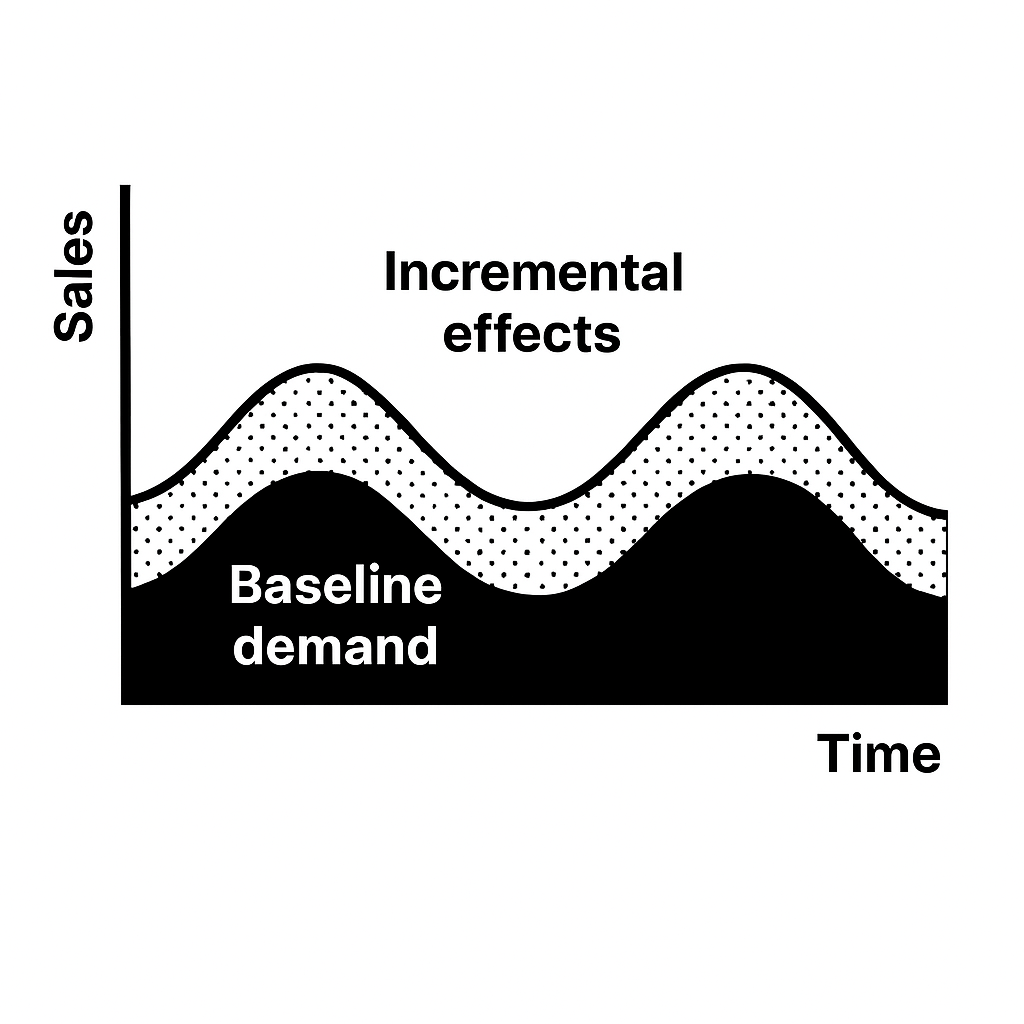
Here's the critical insight: Baseline typically accounts for 50–80% of total sales, depending on industry and brand maturity. In other words, more than half of revenue persists even if you stop advertising entirely.
Concluding that "sales went up, so the ad worked" without knowing this ratio is like judging an iceberg's total size by looking only at what's above the waterline.
Three Problems When You Don't Know Your Baseline
1. Overestimating Marketing ROI
Without Baseline separation, you attribute total sales—not just Incremental sales—to marketing. If you spend $1M on advertising and total sales reach $10M, you report a 10x ROI. But if the ad actually generated only $2M in additional revenue, the true ROI is just 2x.
This isn't a mere numerical error. It leads to executives making budget decisions based on inflated ROI figures.
2. Distorted Budget Allocation Across Channels
Ads running during high-Baseline periods (e.g., Christmas, Lunar New Year) naturally coincide with strong sales. Without separation, those campaigns appear most effective, but in reality, seasonal Baseline was high—the ad's pure contribution may have been small.
Conversely, campaigns during off-peak seasons may show lower total sales, yet their Incremental contribution could be proportionally larger. Without Baseline knowledge, you end up reducing budget for efficient channels and increasing spend during low-efficiency periods—a classic adverse selection.
3. Inability to Predict the Impact of Stopping Marketing
"How much will sales drop if we stop advertising?"—answering this requires knowing the Baseline. Organizations without Baseline visibility fear stopping ads altogether because they can't predict the magnitude of the decline.
The result: unnecessary ad spend is maintained as "insurance," and cost optimization opportunities are lost.
How MMM Separates Baseline from Incremental Effects
Marketing Mix Modeling (MMM) uses time-series regression analysis to decompose sales into contributing factors. The model takes years of historical sales data, marketing spend, and external variables (seasonality, economic indicators, competitor activity) as inputs and statistically estimates each factor's contribution.
The Core Structure of Decomposition
MMM's Sales Decomposition follows this structure:
**Total Sales = Baseline + Σ(Channel-level Incremental) + Residual**
- Baseline: Intercept + Trend + Seasonality + Other control variables
- Channel-level Incremental: Additional sales generated by TV, digital, social, promotions, etc.
- Residual: Variation the model cannot explain
Adstock and Saturation — Why Simple Regression Falls Short
Marketing effects don't appear instantly, nor do they scale linearly with spend. MMM addresses these realities through Adstock and Saturation transformations.
- Adstock: A consumer who sees a TV ad may purchase 2–4 weeks later. Adstock captures this lag and decay, incorporating the carryover effect of advertising spend on future sales.
- Saturation: Doubling your digital ad spend doesn't double your sales. Beyond a certain level, diminishing returns set in. Saturation functions (such as the Hill Function) capture this nonlinear relationship.
Without these transformations, the model over- or under-estimates marketing effects, which in turn distorts the Baseline estimate.
The Advantage of Bayesian MMM
Recent Bayesian MMM approaches leverage prior knowledge to produce reasonable estimates even for channels with limited data. They also provide credible intervals instead of point estimates, enabling decisions like: "TV's Incremental contribution is approximately $1.5–2.3M (90% interval)"—decision-making that accounts for uncertainty.
Practical Application: How Baseline Separation Changes Budget Allocation
Once Baseline and Incremental are separated, the logic of marketing budget allocation fundamentally changes.
Before: Without Baseline Knowledge
| Channel | Budget | Sales Attribution (Simple) | Perceived ROI |
|---|---|---|---|
| TV | $5M | $30M | 6.0x |
| Digital | $3M | $12M | 4.0x |
| Promotions | $2M | $18M | 9.0x |
→ Decision: "Promotions have the highest ROI—let's increase that budget"
After: With MMM Baseline Separation
| Channel | Budget | Incremental Sales | True ROI |
|---|---|---|---|
| TV | $5M | $8M | 1.6x |
| Digital | $3M | $7M | 2.3x |
| Promotions | $2M | $3M | 1.5x |
→ Decision: "Digital has the highest incremental ROI—let's shift budget toward digital"
Same data, same budget, but Baseline separation leads to opposite conclusions. The high sales during promotional periods were actually driven by seasonal Baseline, and the promotion's pure contribution was relatively small.
Optimization Simulation
With Baseline established, scenarios like "What if we cut TV budget by 30% and reallocate to digital?" become possible. Since Baseline remains fixed while only the Incremental portion varies, you can realistically estimate how budget shifts will impact revenue.
This is the difference between simple reporting and data-driven decision-making.
Summary: Knowing Your Baseline Is Where Marketing Strategy Begins
- Baseline Demand: is the structural revenue that persists without marketing, typically accounting for 50–80% of total sales
- Failing to separate Baseline leads to overestimated ROI, distorted channel allocation, and unpredictable outcomes when marketing stops
- MMM uses Adstock and Saturation transformations with Bayesian estimation: to statistically separate Baseline from Incremental
- Separated data enables true channel ROI comparison, budget reallocation, and scenario simulation
Even if you haven't attempted Baseline separation yet, there's no need to worry. What matters is starting with the question: "How much of our revenue is structural demand, and how much is created by marketing?"
If you need to separate Baseline from Incremental and optimize budgets based on those insights, MadMatics Action MMM is ready to help you get started.