[C-Level Report] Designing Marketing Taxonomy That Doesn't Fail
When data is accumulated but taxonomy remains unorganized, strategic interpretability suffers and business impact is limited. We introduce the expanded role of taxonomy through three pain points in marketing practice.
In MMM consulting, we frequently encounter cases where data has been accumulated but the taxonomy is not organized, resulting in weak strategic interpretability and limited business impact.
This newsletter addresses that concern, focusing on three pain points commonly observed in marketing practice to introduce the expanded role of taxonomy.
- Marketing direction – taxonomy
- Marketing budget efficiency – taxonomy
- Marketing ROI improvement – taxonomy
What Is a Taxonomy?
Simply put, a taxonomy is a classification system. It serves as a strategic language dictionary for collecting and reading data under consistent standards.
Taxonomies are already widely used across various departments in enterprises:
- Logistics & Production: Product codes, SKUs, part numbers → managing production, shipping, and inventory under unified codes
- Accounting & Finance: Chart of accounts, cost/revenue centers → the entire financial statement is built on these codes
- Product & Distribution: Categories, lineups, channel segmentation → the foundation of retail/e-commerce sales reports
- CRM: Segments, tiers, lifecycle tags → the operating unit for tier-based benefits and campaigns
In other words, taxonomy already serves as the grammar of business operations, and marketing is no exception.
1. Taxonomy for Marketing Direction
Marketing is completed at the point of contact with consumers, after planning, production, and logistics.
In particular, marketing campaigns are the execution and validation of positioning strategy—the process of securing and expanding consumers' mental availability.
However, in many organizations, brand campaign records are limited to campaign names or phases like "launch/mid/close," missing strategic axes such as messaging, targeting, and timing. As a result, even brand campaigns are often evaluated solely on digital conversion metrics.
But the original purpose of brand campaigns is to execute, manage, and lead brand portfolio strategy and consumer positioning in the market. A separate brand campaign taxonomy aligned with this purpose is needed.
I propose the 5W1H Framework for this purpose.
This approach systematizes campaigns by why, who, when, where, what, and how the message was delivered.
By quantifying brand values, targets, messages, and purchase triggers, we can move beyond simple "good/bad" evaluations to modify strategies based on quantitative evidence and increase brand selection probability.
Example: Brand Campaign 5W1H Taxonomy
| Category | Field Example | Description |
|---|---|---|
| WHO | lifestyle_cluster: Trend Leader, Family-oriented | Verifying consumer response by lifestyle/message target |
| WHEN | season_event: Summer Holiday, Mega Sale | Timing strategy aligned with seasonal/event context |
| WHERE | channel_portfolio: Instagram, Flagship store | Digital/offline channel management |
| WHAT | product_offer: Summer Collection, 20% Off | Linking product/offer/price to conversion points |
| HOW | creative_asset: UGC Video, Friendly Tone | Brand image expressed through creative type/message/CTA |
→ This enables quantitative evaluation of how the intended positioning strategy is received in the market through qualitative metrics (awareness, preference, trial, etc.), allowing you to measure, manage, and lead brand metrics in the intended direction.
2. Taxonomy for Marketing Budget Efficiency
Once direction is aligned, fuel efficiency management is needed.
No matter how impressive a campaign is, if the budget structure is inefficient, business impact will inevitably be limited.
Most ROI calculations are based on media costs only. But actual ROI must include production costs.
For example, if production costs account for 50%, ROI starts at half regardless of how efficient the media is.
Therefore, campaigns need a taxonomy that enables cost efficiency verification.
- Separate non-working money: specifically: Research, consulting, services, and production items must be transparently recorded. This reveals which items consistently fail to contribute to revenue.
- This isn't about cutting costs blindly. Budgets are limited, and reducing waste enables spending on better creative.
- Add agency fields: per campaign: ROI can be evaluated reflecting not just media performance but also production costs and services.
This allows agency evaluation based on quantitative ROI rather than relationships or gut feelings, and collaboration with procurement teams becomes much smoother.
Example: Production & Agency Taxonomy
| Category | Field Example | Description |
|---|---|---|
| AGENCY | agency_name, role, fee_structure | Recording which agency collaborated under what terms |
| PRODUCTION | creative_count, versioning_cost | Managing output volume and cost efficiency |
Example: Agency ROI Evaluation Chart
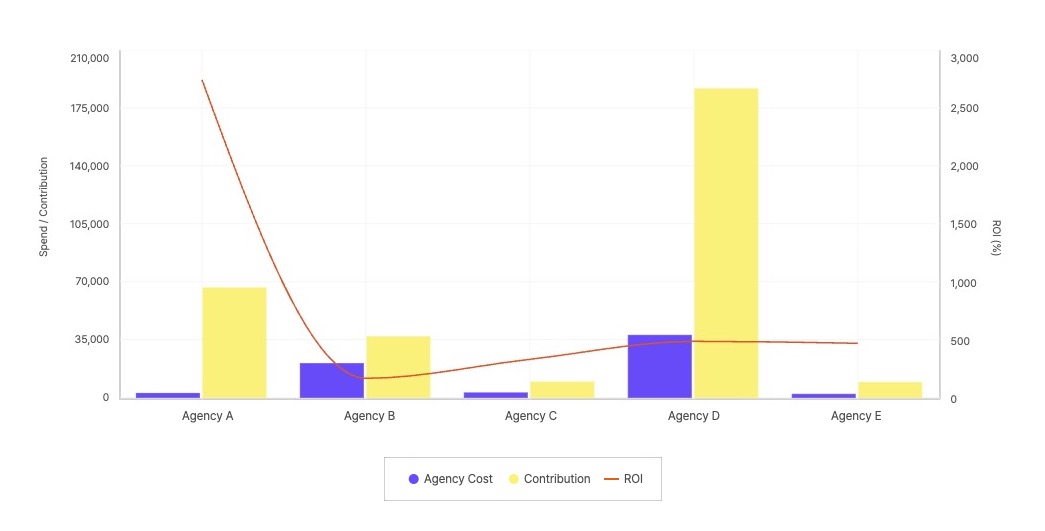
This chart compares Agency Cost structure, Contribution, and ROI curves side by side. Key insights: (1) Identifying agencies with significant cost-contribution imbalances, (2) Confirming high-ROI partners for efficient reallocation, (3) A visual indicator showing who contributed efficiently, not just how much was spent.
3. Taxonomy for Marketing ROI Improvement
Our data now has taxonomies covering direction and efficiency. But real performance improvement doesn't end here. The core of marketing science is Hypothesis & Test.
In fact, all taxonomy columns discussed so far—brand direction (5W1H), cost and agency management—ultimately converge into testable hypothesis units. Because both strategy and efficiency ultimately come down to the question: "Will this choice lead to results?"
Whether making data-driven decisions or executing based on experience, every campaign needs a hypothesis. And that hypothesis must be labeled with taxonomy to compare and learn from results.
- Hypothesis: Applying discount promotions to top-clicked products will increase conversion rate by +20%.
- Hypothesis: Switching interest targeting to healthcare will reduce CPM by -15% and increase conversion by +10%.
- Hypothesis: Deploying long-form creative will expand reach and improve purchase rates.
- Hypothesis: Launching new products online-only on a single channel will improve Trial Rate by +25%.
As data accumulates, each hypothesis receives a verdict: Accepted, Rejected, or On Hold.
- Accepted: Sales increased +18% as predicted → expand application next quarter
- Rejected: No expected effect → cannot re-execute, explore different messaging
- On Hold: Some improvement but below threshold → revise conditions and retest
When visualized in charts, this process becomes even clearer.
For example, comparing sales curves between periods with and without a specific hypothesis reveals not just "good/bad" but *which hypothesis actually drove performance* in an intuitive way.
In other words, the essence of ROI improvement is not more budget execution, but faster hypothesis validation cycles.
Quickly rejecting failed hypotheses and rapidly expanding successful ones—this is why taxonomy becomes the engine of ROI improvement.
Example: Hypothesis-Based Taxonomy
| Hypothesis | Expected Effect | Result | Verdict |
|---|---|---|---|
| interest_target_healthcare | CPM -15%, Conv +10% | CPM -12%, Conv +8% | On Hold |
| creative_longform_video | Expanded reach | No effect | Rejected |
| new_launch_online_only | Trial Rate +25% | +28% | Accepted |
Example: Hypothesis Marketing Effect Visualization Chart
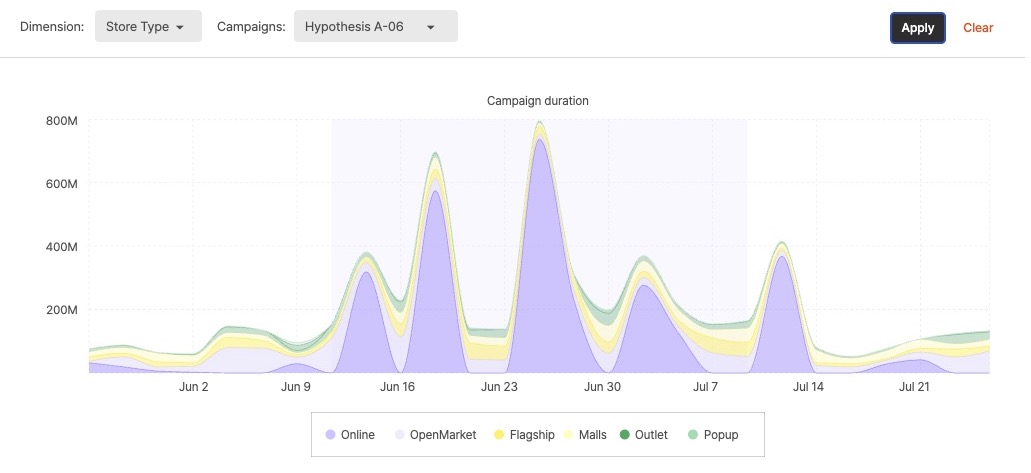
This chart visualizes time-series changes in sales (or contribution) during the campaign live period by store type. The highlighted hypothesis application period can be compared against non-application periods on the same scale. Key insights: (1) Slope changes immediately after hypothesis application (rise/flat/decline), (2) Residual effect after application ends (decay rate), (3) Differences in contribution patterns by store type.
Conclusion: The Virtuous Cycle of Strategy-Execution-Validation
When marketing taxonomy is well-built, the following cycle becomes possible:
- Weekly meetings: Hypothesis validation review
- Monthly meetings: ROI review by taxonomy and direction check
- Quarterly reviews: Portfolio strategy realignment by adjusting Why/Who axes
- Annual planning: Building evidence for growth strategy and budget allocation that doesn't fail
By applying three expanded taxonomies and running weekly-monthly-quarterly cycles, evaluation goes beyond "good/bad" to deliver real results. Decision speed increases, budgets are reallocated toward high ROI, and brand metrics (awareness, preference, trial) rise in the intended direction. Failed experiments are quickly shelved and successful hypotheses rapidly scaled—reducing waste and growing performance. Ultimately, taxonomy becomes the language for interpreting strategy that enables growth that doesn't fail.
Even if your taxonomy isn't ready yet, there's no need to worry.
Through APIs and retroactive application, past data can be reinterpreted in strategic language.
If you need marketing taxonomy consulting and implementation, MadMatics Action MMM will be there to start the journey with you.